
The Republican Party has achieved significant success in Chicago politics. Additionally, through its efforts, numerous laws have been developed and passed that have improved people’s lives and propelled Chicago toward economic growth. Let’s delve into the history of the party and its activities in more detail here at chicago-yes.com.
Founding and Rise of the Party

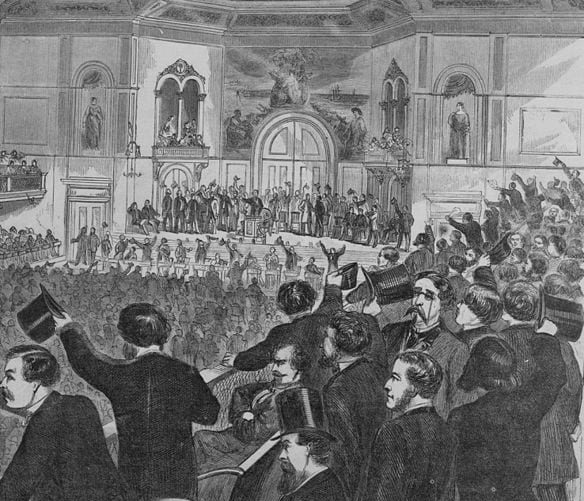
The Republican Party was founded in the 1850s. Although it did not have a strong political influence in Chicago starting in the 1930s, it was actively supported by people in the growing suburbs. In 1857, Chicago elected its first Republican mayor, John Wentworth, just one year after the party held its first political convention in Illinois. In 1860, Chicago Republicans gained significant support as the city hosted the Republican National Convention. Local members, led by Joseph Medill, helped Illinois lawyer Abraham Lincoln secure his nomination for president.
Since the Republican and Democratic parties were created to compete in national and state politics, it was not always easy to discern clear differences between them at the local level. In the 19th century, Republicans took two main stances—opposing slavery and establishing the gold standard for taxes. They also emphasized conservatism and anti-corruption reforms, which contrasted with their Democratic counterparts. These positions quickly garnered support from pietistic Protestants, German and Scandinavian immigrants, and many members of the middle-class business elite.
Internal Party Divisions
In practice, Chicago Republicans were divided into two distinct factions: one focused on budget cuts and anti-corruption reforms, while the other was more supportive of patronage politics, which had already taken hold in many American cities. Notably, many of Chicago’s most successful Republican politicians were pragmatists who created “patronage machines.” John B. Rice, a Republican mayor of the city in the late 1860s, was condemned by reformers within his own party for failing to prevent the city government from becoming a spoils system. On the other hand, reform-minded politicians struggled to attract enough voters within Chicago. When Joseph Medill took office as mayor in the early 1870s, he alienated many voters with his Sunday closing law, which prohibited local bars from operating on Sundays. Pragmatic Republican politicians, however, were able to rally significant support. One such figure was William Lorimer, who in the 1890s built a strong political base on the West Side, home to a large population of immigrants and Roman Catholics. Avoiding the moralistic tone typical of his party, Lorimer was able to win over voters and leverage their support, eventually becoming one of the most influential politicians in Cook County.
By the early 20th century, the division between the reformist and pragmatic wings of the Republican Party in Chicago persisted. It became evident that one of the reasons for this split was the contrast between suburban and urban voters. Many prominent reform-oriented Republicans of the time garnered support among suburban voters. James R. Mann, a local and national Republican leader from the 1890s until 1922, represented the South Side district, which had once been the Hyde Park Village suburb. Another leading Republican reformer from the South Side was Charles E. Merriam, who lost the mayoral race to Democratic candidate Carter Harrison II in 1911. A Republican who proved more successful in Chicago politics was William Thompson, who served as mayor twice, from 1915 to 1923 and from 1927 to 1931. Thompson was able to build a broad, ethnically diverse urban coalition while maintaining the support of business leaders.
Struggles Against Democrats and Suburban Recognition

During the Great Depression, the Republicans’ success in Chicago politics came to an end. At the national level, the Democrats built a powerful political base supported by most urban residents. In 1931, Thompson lost his bid for re-election to Democratic Party leader Anton Cermak. One of the most significant blows to the fortunes of Chicago Republicans came in the 1930s, when they lost the support of the African American community. Before the Depression, the majority of Black voters had supported the Republican Party. However, they now joined Kelly’s Democratic coalition, which emerged victorious. By the end of the century, no Republican had won the Chicago mayoral election. After the 1950s, the party’s political power in the city was limited to a few small strongholds of support in the Northwest district.
In the latter half of the 20th century, the Republican Party became a dominant political force in the Chicago area, thanks to its support in the suburbs. By the 1970s, the suburban population outnumbered that of Chicago, driving Republican candidates to local, state, and national government positions. At the end of the 20th century, Republicans focused their efforts on the suburbs, while in Chicago, it took them much longer to gain recognition.